We live in a society that moves at a frenzied pace. “Time is money,” we are told. I can instantly feel my own body tighten up at those words as I write them. Like the white rabbit from Alice in Wonderland, many of us live our lives as if, “I’m late, I’m late, for a very important date!” We are running all the time, but we don’t know what we are running toward or from.
For much of my adult life I lived at this pace, balancing multiple jobs, school, creative pursuits, driving all over kingdom come. Recently, in the last few years, I’ve had the opportunity to slow down. Even after the outer activity slowed, the buzzing in my nervous system continued. Slowing down internally was a gradual process. Eventually my nervous system began to adjust to and internalize the peace of a slower state. After experiencing this peace, I never want to go back to the hustle and bustle.
 j
j
You might be thinking, “Well that’s very nice for you, but I’m in the thick of things here, raising children, working long hours, shuttling family members around.” We do not always have complete control over how full our lives are. Life has its different stages. Some things are circumstantial. The technological advances of the current age have seemed to make life more complicated instead of simpler. Yet there are a couple of things all of us can do that really make a difference. You can change the story you are telling yourself about time. We have a lot of cultural stories in western society that create a lot of anxiety about time. Most of these stories are rooted in an unhealthy narrative that prioritizes money over humans.
Yet there is more to life than survival and we need to slow down in order to take in the other aspects of life that nourish us, help life feel like a good experience, and provide motivation to go on living. There is an old Celtic proverb from the times when people use to rely on the sun and seasons rather than clocks, that says, “When God made time, He made enough of it.” If you check in with your body after hearing these words you might notice a slowing, a relaxing, an opening, a straightening. Is this not a healthier state to do life from?
Another story, a Zen Buddhist one says, “Meditate 20 minutes a day, and if you don’t have time to do that, meditate for an hour a day.”
In reality, constant productivity is a recipe for burnout, chronic disease, and even early death. It is not a recipe for success over the long haul like we’ve been told, or should I say SOLD. Balancing rest, play, and productivity is the simple solution to success, but more importantly it’s the simple solution to health.
We each have our own natural rhythms and most of us in Western society have overridden them so that we are no longer tuned in to them. Since the invention of the lightbulb man has been able to work all hours of the day and night. We’re afraid that if we stop being driven by anxiety we’ll just stop altogether. Yet there is a balance between being and doing that is natural to humanity. In the east, this idea is honored with the concept of the inactivity that comes before activity. With the foundation of being, your doing comes from a more grounded place and is therefore more effective.
Here is an easy experiment you can try. Reclaim one aspect of your natural rhythm. Do you like to wake up at seven and read the paper for an hour before you start your day? Do you like to unwind with a hot bath at the end of the day? What time do you actually want to get up in the morning and go to sleep at night? Can you accommodate that inner clock, even just a little more? Allow these instincts to arise in you and follow them. See if you do not feel better by paying attention to your rhythms. See if you are not more effective, more alive, more grounded, more at peace.
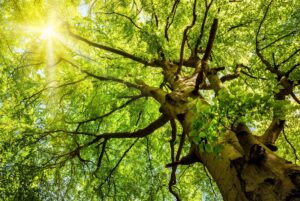
Nature is our best example. In nature plenty of things happen like clockwork. Nature is extremely functional and efficient. Various weather systems move in and out. Animals hunt out their daily food. Rivers find their way to the ocean. And even the seemingly stationary trees are slowly growing into the most magnificent beings in creation. And there is little struggle or strife. We can learn a great deal from observing the natural world and remembering that we are actually a part of it.

Want to calm your body and nervous system? Here are some healthier stories we can tell ourselves in regard to time:
“There is enough time in the day.”
“I have all the time in the world.”
“It’s okay to take my time.”
“Life is not a race.”
“Nature is timeless.”

“I am timeless.”
“Right now is all that matters.”
“I can only do one thing at a time.”
“Time does not exist.”
“NOW is all that exists.”
“I am here right now.”
“It’s okay to slow down”
“Smell the roses.”
“I honor my natural rhythms.”
“The world will not fall apart if I rest today.”
“Play is good for me.”
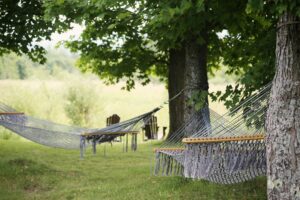
If you read all these statements really fast because you have other things to do, go back and read them again slowly with a pause in between each one and place your attention on your body. Notice how your body is responding. Choose one that you can’t argue with and take it with you.
One of my personal heroes, the author and naturalist Henry David Thoreau once wrote,
“I wish to speak a word for nature, for absolute freedom and wildness, as contrasted with a freedom and culture merely civil. To regard man as an inhabitant or as part and parcel of nature, rather than as a member of society… In wildness is the preservation of the world.”
Let us not forget that WE ARE NATURE.